<< back to talent optimization and culture articles
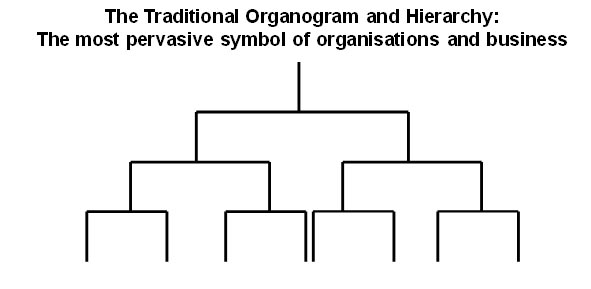
When I engage with MBA students at the University of Stellenbosch Business School, I ask them to think about and draw what they think is the most recognizable symbol of business. The single most common symbol they come up with is the traditional organogram depicting the hierarchy. I get the exact same response within clients, regardless of the level of management I’m working with. The seemingly ubiquitous symbol of business may at first glance not be cause for any concern. It’s so deceptively simple and apparently non-toxic, yet it reflects a value system and related sets of behaviours that are as antiquated as they are repulsive – a true denial of the vibrancy of human life and creativity! It intrinsically depicts systems of management and leadership that are not capable of delivering sustainable performance and competitive behaviour from and happiness for people, nor unleash the wonderous and largely benign energy of humanity.
In her marvelous book, Finding Our Way, Margaret Wheatley invites us to engage in the telling of a new story that is capable of creating organisations that are fit and friendly for human life; places where the wisdom of Confucius can come alive when he stated many generations ago: Find what you love to do and you will never work again! He taught that Work is Love made Visible! One of the 20th Century’s greatest business thinkers and philosophers, Peter Drucker observed that organisations of the future that are capable of delivering sustainable competitiveness will have to be developed and run on the principle of LOVE. Are these the sentiments of fools, or do they hold the wisdom required to provide an entirely new way of looking at leadership and organisations, particularly business? The one thing that all of these commentators have in common is their belief that the way that organisations are generally managed, and the approaches of leadership that they largely rely upon, is simply not sustainable. Perhaps one of the most tragic indictments of modern management is that survey after survey demonstrates that very large numbers of employees are not truly happy, energised and enthused at work. A minority of employees report that they are fulfilled by and feel that their jobs recognise and harness the fullness of their creative being. Since the mid 1980s my colleagues and I have been assessing the extent to which employees across the full spectrum of the economy feel that their organisations have practices that stimulate and encourage their creative and full productive human capacity. On a scale of 1 to 9, with anything above 6 demonstrating very positive perceptions, the average South African employee rates his/her organisation below 4! Yet we have also found that organisations that manage to transform themselves and achieve ratings of above 6 and into the range of excellence (above 7) report the following:
- Increased employee satisfaction
- Leaps in brand reputation and customer satisfaction
- Sustained improvements in share prices
- Increased ability to attract and retain talented people
- Sustained improvements in performance across a range of indices
Sadly, less than 1 in 10 organisations at first get close to these ratings. What does it take to embrace and achieve this seemingly rare feat? One if the world’s most respected business gurus, Gary Hamel, tackles this challenge in his latest book, The Future of Management. He calls for no less than a fundamental transformation of our mental models on how business must be managed and how leaders need to operate. So, what does the challenge of New Economy Leadership look like? It is a topic worthy of several books, but there are just a four essential, universal truisms that we need to acknowledge and turn into the founding principles of organisational life before we even consider more detailed dialogue:
1. Organisations are HUMAN systems
2. Human Systems are Chaordic
3. Organisations are Living Webs of Leadership and Relationships
4. Leadership is about roles and contributions, and not about positions
Organisations are HUMAN systems:
Organisations are first and foremost human systems. It stands to reason that they should be designed to reflect and reinforce human conditions and realities. Yet the sad reality is that the vast majority of organisations are still designed and run to be about as fitting for human life as zoos and circuses are for wild animals. We need look no further than the phenomenon of traditional village life to witness the beauty of human energy and existence. Here people wander in and out of one another’s lives with the energy of support and meaning for one another. It is a place where the entire village consists of shared meaning and the innate will to survive beyond generations.
There is a very real case to be made that many of the ailments of modern, urbanized and affluent society can be attributed to the breakdown of the village. Endemic obesity, depression, child abuse, divorce, family breakdown, loneliness, suicide, rape, crime, can all be related to the loss of village life. This does not mean that we must romanticise the village of yore, but rather that we need to recognise that people are first and foremost social beings. So, what can and has to take the role of the village in the space of human existence? The modern organisation is to all intents the manifestation of the new village…..it is after all the place where we spend the majority of our waking existence. It is also the place where we invest the majority of our productive endeavours – and where we at least expect and hope that our employees will invest the majority of their creative and productive being. But then we need to rediscover how to design and run our organisations so that they can also fulfill the social and human requirements, and the essence of being human – of being part of the village. To do this we need to craft organisations that encourage and stimulate dialogue, transparency of information, honesty and robustness of normal human discourse, and above all else deeply valuing the mosaic of human diversity. New Economy Leadership perpetually asks how to craft organisations and engage people to create spaces and places that offer compelling and joyful opportunities for humans to flourish.
Human Systems are Chaordic:
Dee Hock, the founder of the VISA credit card organisation, coined this term in his autobiography. He explores the necessity to appreciate that life is a rich broth of chaos and order. It is chaordic! Our remarkable human condition enables us to make sense of the most extraordinary unpredictabilities of life. I think it is Robert Oppenheimer, a Nobel Physics prize winner and one of the 20th Century’s great thinkers who said, “Life and the universe is unpredictably chaotic, unspeakable violent, and morally neutral.” I like to add to this, “and endlessly creative!” Every person that pitches up at work every morning lives and generally does a damn fine job at fulfilling a life of extraordinary complexity. All of us cope with the delicate interplays of birth, death, sickness, aging, children, family, friends, enemies, loss, opportunity, fears, hopes, jobs, incomes, debt, wealth, poverty, life stages, pain, joy…….the whole gamut of human experience. Why, if you’re American you even have to cope with Bush as president! In fact, I have an increasing suspicion that people come to work to for moments escape the insanity of life!
So why is that when these same miracles of existence pitch up at work the majority of organisations and managers feel compelled to treat them like fools who cannot or will not think and act and dream and relate at work in the same marvelous ways they do most of the time outside the workplace? And why is it that these same miracles of being allow themselves to be subordinated and submerge themselves to become impoverished effigies of their full magnificence? One of South Africa’s greatest leaders, Steve Biko perhaps captured this strange interplay when he stated that, “The greatest weapon in the hands of the oppressor is the mind of the oppressed!” New Economy Leadership daily gives a standing ovation to the capabilities of the power of people and the willingness, nay desire of humans to be creative, responsive, and simply alive. As I write this the words and music of Pink Floyd spring to mind:
“We don’t need no education,
we don’t need no thought control,
no dark sarcasm in the classrooms,
teachers leave the kids alone,
hey teacher, leave the kids alone!”
New Economy Leadership endeavours to engage people to break these bonds that are often so deeply laid down by our socialisation processes, and to instead pitch up to work fully human. The author and Jungian analyst, Robert Johnson notes we spend the first half of our lives adapting to and fulfilling the requirements of our culture; and the second half of our lives recovering from it! New Economy Leadership accelerates and encourages this recovery process!
Organisations are Living Webs of Leadership and Relationships:
Let’s return to that silly yet omnipresent organogram. It consists of neat, clear and clean lines of communication and control, clarity of levels of accountability, a veritable oasis of sanity and rationality in an ocean of chaos and uncertainty…………….ONE problem, it doesn’t exist! The ONLY way to maintain this traditional hierarchy is through the continuous exertion of adequate coercion, fear and authoritarianism. This may have been possible in generations gone by when humans were willing to submerge their interests and tolerate the erosion and ultimate destruction of their dignity in the interests of a saddening sense of (false) security. True, there are still thousands of executives who seem to believe that they can run organisations based upon these principles, and they get rewarded richly for creating the impression that they are in control. What we are however seeing is that their antics are not sustainable. No sooner have these throw backs to the caveman departed and their successors have to plead forgiveness for the follies of their predecessors.
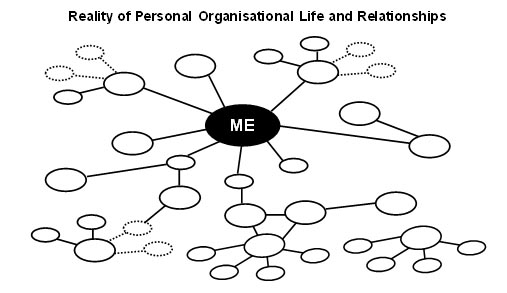
Vibrant and sustainably competitive organisations instead recognise that in reality organisational life and human interactions resemble living webs of leadership and relationships. Every individual within an organisation can draw his or her web of interactions that cut across levels and silos. Just one individual’s web starts to look something like this:
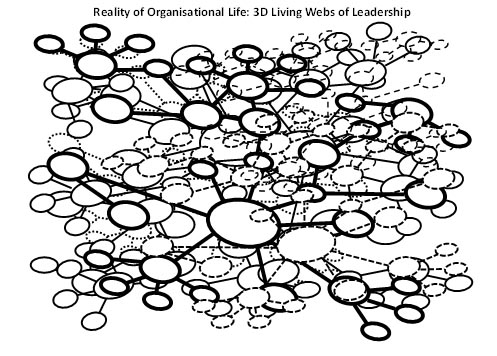
The moment we add the living reality of multiple individual, team, departmental and divisional webs a SIMPLIFIED version of life starts to looking like Darwin’s wonderful description of life as an river embankment of intertwined flowers, grasses, insects, colours, scents, soils and flavours in which there is no hierarchy of importance, but rather only a symphony of life. It is useful to remind ourselves of the fact that in his seminal work Darwin stated, “It is not the strongest of the species who survive, nor the most intelligent, but the most responsive to change.”
Most latter day economists, politicians and business leaders (from predominantly Caucasian, developed and erstwhile colonialist countries) have co-opted and misrepresented this famous insight to fit their own values that are still aligned to the traditional hierarchy of power and privilege. Instead of digesting and incorporating the complexity of Darwin’s historic insight, they have contaminated it to validate a lesser and unsustainable philosophy of survival of the fittest, strongest, and in fact the meanest.
The true reality of human and organisational life gives credence to Darwin’s view of life, rather than the aneamic version represented by the good old organogram and hierarchy. In truth all that is happening is that organisational life and leadership is catching up to the fact the inexorable evolution of human existence and thinking is steadily progressing towards the significantly more complex and disorderly systems of democracy. Ricardo Semler, the author of Maverick as well as The Seven Day Weekend, captures this reality so well when he states that democracy is much messier than autocracy. Likewise Winston Churchill stated that democracy is a very flawed system, but it is the best one we have. Slowly but surely this realisation is filtering through to organisations and leadership. So, what does it look like?
Leadership is about roles and contributions, and not about positions:
How on earth do we make sense of this seemingly uncontrollable mess? Simple. By acknowledging and starting to lead our organisations with the firm belief that being human is about being a leader. Leadership is a role that is diffused and permeates every second of every day wherever human beings are alive and responding to the endless challenges and opportunities afforded by life. Marcus Buckingham led great break through research which was reported in the best seller, First Break All the Rules. In it he and his colleagues illustrate that some of the primary drivers of human contribution are
- comprehension of what is expected of one;
- consistent feedback and appreciation of work done well;
- continuous stretch and development;
- opportunity of doing something meaningful on a daily basis.
This aligns with the only way in which we can make sense of the chaordic and real existence of human and organisational life. We need to eliminate the puerile belief that we can control and impose sense onto a system that is inherently creative, unpredictable and consistently evolving – in a nutshell, something that is human! The way in which the village coped with this was to always to define and attribute roles. The hunter, gatherer, herd boy, water fetcher, care giver, shaman, elder, and every other role contributed something essential to the sustainability of the community, to the vibrancy of the village. Likewise the research of Eliot Jacques, Gillian Stamp and latterly Ram Charan and Stephen Drotter (The Leadership Pipeline) proves that the clarity of leadership roles and definition of expectations provide the cornerstone for humans to contribute to the best of their capability and joy. In this view of the organisation leadership is not about positions or titles. Instead it is about the sheer beauty of providing individuals and teams with the clarity and focus of doing and being involved in something meaningful on a daily basis. It is all about giving people the opportunity of ensuring that they keep the organisation busy, rather than the organisation keeping them busy!
Five distinct leadership roles become apparent when we look at organisations and humans through these lenses. Each role contributes to, feeds into and is fueled by all other roles. A useful metaphor is to compare it to various levels of complexity of music, namely:
Personal Harmony and Chanting
Collective Drumming
Symphony Orchestra
Jazz
Experimental Jazz and Avant Garde
Each of these levels of music is both satisfying and compelling. Entire schools of thought and practice have been developed around each one. Each level has its own intrigue and value, yet none are truly independent and have no ultimate isolated existence. They are all interdependent, as is life itself.
The exact same is true of the roles of people beyond the hierarchy and organogram. The expression of living webs of leadership and life offers a tantalizing feast of work that holds the promise of turning organisations into places of human artistry and enjoyment. Just an introductory glimpse of what this offers to people across levels and silos already sets the scene for viewing organisations and leadership in a truly transformed manner.

Chaordic Leadership (Experimental Jazz and Avant Garde)
- Custodians of long-term sustainability
- Leadership of Flow of Consciousness
- Leadership of Strategic Intent
- Leading Organisational Resilience and HPO Culture
- Positioning the organisation as a social entity
- To the HILT: Enhancing the larger community through High Impact Leadership and Teaming (HILT)
Peak Leadership (Jazz Band)
- Custodians of Integration and
Enterprise
Wide Leadership - Leadership of HPO Enterprises and Webs of Resilience
- Leadership of Strategy Execution
- Translating HPO Culture into operational execution
- To the HILT: Building High Impact Peer Webs and Teams
- Sustaining the Crucible for Leadership of Abundant Talent
Edge Leadership (Symphony Orchestra)
- Custodians of Innovation and Intrapreneurship
- Leadership of BOPs and Continuous Improvement
- Leadership of HPO People Practices
- Adapting and driving HPO Culture to operational realities
- To the HILT: Building High Impact Leadership Teams
- Mastering the art of being the Leader-Teacher-Learner
Leadership Leap (Collective Drumming)
- Custodians of Fluctuating and Non-Coercive Leadership
- Leadership of Self Organising Teams
- Leadership of Forthright and Courageous Conversations
- Applying Development al Performance Discussions
- To the HILT: Valuing and Optimising Team Diversity
- Mastering the Art of Participative Leadership
Leader Within (Personal Harmony and Chanting)
- Custodians of Personal Authorisation and Empowerment
- Defining and developing Personal Leadership Authenticity
- Leadership of Personal Development Journey
- Utilising reflection and feedback for personal growth
- To the HILT: Exercising Personal Leadership Power
- Exercising Personal Rank
As we navigate our way into the 21st Century we face the undeniable challenge of developing and entrenching new ways of managing and leading organisations – be they governmental, private or public sectors. At the heart of this lies the challenge of New Economy Leadership – what could be more human and endearing?!