
<< back to personal effectiveness and balance articles
If you speak to anyone
who has had the privilege of meeting a great leader, phrases such as “he has
such a presence” or “he is so charismatic” are bound to emerge. It is expected
that the true leader will not only "do or say the right things" but
will radiate leadership qualities from his/her being, embodying the notion of
leadership at all times. In laymen's terms, one could frame the embodiment of
leadership as 'presence', 'somebody who is sure of him/herself, 'who mean what
s/he says', 'somebody who can be trusted' and 'care about people'. How are
these elements/expectancies embodied? How can one observe the presence thereof
in non-verbal communication? As communication specialists we found ourselves
intrigued, and this lead us to examine non-verbal patterns in iconic leaders.
The body and the voice are the only two physical sign systems at play during
communication, and congruent use thereof is of vital importance to 'get the
message across', influencing how the message is perceived. But
paraphrasing Damasio, we are always functioning as a multiple presence of the
self. As such, one should never tag a direct meaning to another's 'body
language' without substantial observation. Personal uniqueness and culture play
major roles in the use of the body as a sign system. We read other's bodies
from the perspective of our own personal and cultural patterns. What one may
perceive as a disrespectful body pattern may actually be a sign of respect from
the other person's cultural paradigm. Yet, there are certain truths about
non-verbal communication that exceeds the notions of personal uniqueness and
culture, and we have examined these as a potential base of leadership impact.
The work of scholars such as Birdwistell, Delsarte and Eckman provide
information about these patterns, and the fundamental principles of all human
movement, as framed by the theories of Laban/Bartenieff, can further be used as
guidelines when decoding body language with specific reference to functional
and expressive patterns. Allow us to unpack some of these elements whilst
referring to two respected leaders: President Barack Obama and Former-President
Nelson Mandela.
Observing and analysing the body patterns of these iconic leaders, it is evident that they both:
Have presence: They are both grounded in their movements. They both stay centred, seldom leaving their own personal space, with the pull line of gravity flowing directly through their bodies when in the upright position.
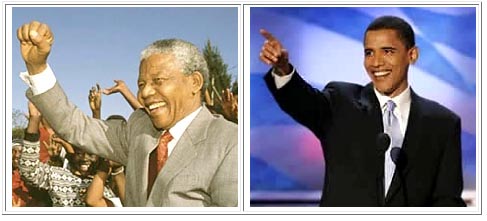
Sure of himself and can be trusted: They both spread and widen
in their upper bodies. They both have a good head-neck relationship with the
crown of the head the highest point of the body. They both make use of open
movements from the centre of the body outwards when sharing information.
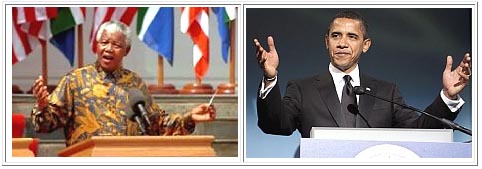
Mean what they say: In their gestures there is integration between the energy and intent present at the core of the body, and the energy and intent that is present in the gesture. There is thus a congruency between what is meant and what is said.
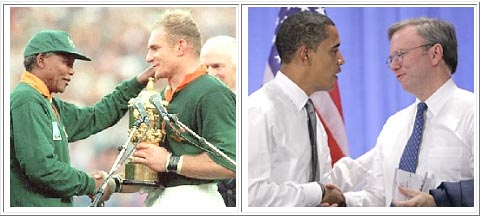
Care about people: Both Mandela and Obama shape within the upper body and lean slightly towards the person that they are communicating with, without compromising their own space. Mandela in his later years has a tendency to lean more forward – especially reaching out to make contact with people. It is as if he has softened and pays more attention to how the people that he is interacting with feel. It can be speculated that this is a reflection of where he is in his career and life's journey. Obama displays slightly less but the same softening and shaping of the upper body when communicating directly with one other person. He furthermore tilts his head slightly to the side as an indication that he is listening attentively to the other person.
Where does this leave us - leaders in business and leaders in the making?
Is it a case of one either has it or one doesn't. No. It does not have to be that way. Through guidance we can all learn to embody our thoughts and feelings. We can all learn to support our verbal messages with our body language. All it takes is an awareness of habits, organic movements, and congruency of the sign systems used during communication.