
<< back to business development and networking articles
Some definitions:
- A network is a set of connected relationships with people inside and outside your organisation upon whom you depend to do your work. Within your network you share information, collaborate and solve problems.
- Networking is the process of gathering, collecting and distributing information for the mutual benefit of you and the people in your network. You are not selling, you are telling. You are not asking for favours, you are giving valuable information, help or support.
- Networking - creating a fabric of personal contacts who will provide support, feedback, insight, resources and information.
- Leadership networking is about building relationships and making alliances in service of others - customers, clients, constituents, peers, bosses, and employees - and in service of the organization's work and goals. A robust leadership network helps provide access to people, information and resources
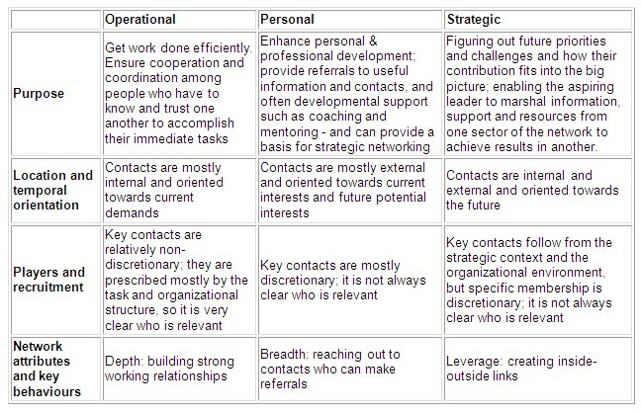
3 Distinct but interdependent types of networking:
- Operational - to help the person manage current internal responsibilities
- Personal - to help boost the person's personal development
- Strategic - to open the person's eyes to new business directions and the stakeholders they would need to enlist - almost everyone underutilizes this
Networks deliver 3 unique advantages:
- Private information: public information is easily available - to make good decisions we also need the private information that is less readily available - the quality of this information depends on the level of trust in your network
- Access to diverse skills sets: individual success is tied to the ability to transcend natural skill limitations through others
- Power: traditionally executive power was embedded in a firm's hierarchy. When corporate organisations became flatter, that power was repositioned in the network's information brokers. The most powerful brokers are those that connect separate clusters. Cultivate powerful brokers - particularly those who aren't in positions of formal authority (since that is the place where everyone else looks)
The 6 critical requirements of leadership networking
- Leadership networking demands authenticity: have a genuine objective of building relationships providing support, and accomplishing the work for the benefit of the organisation. Authenticity generates trust. People will see through networking that is self-serving or manipulative.
- Leadership Networking trades in resources: your resources include information, services, access and power. Know your assets and share/barter them
- Leadership
Networking calls for thoughtful and deliberate use of power: power is
defined as the ability to get things done. In the context of Leadership
Networking, there are 3 types of power:
- Positive Reputation gives you power
- Connections to key influencers and decision makers gives you power
- Your involvement with the organization's more important priorities/problems gives you power
- Leadership Networking requires skilful communication: you need to make others aware of what you can offer
- Leadership Networking calls for savvy negotiating skills
- Leadership Networking means managing conflict
Barriers to building a Leadership Network
All the following sorts of difference can make Leadership Networking more difficult:
- Operational differences: e.g. adversarial culture, networking being counter-cultural
- Level differences: networking up/down
- Demographic differences: networking with people who differ with respect race, gender, age, county of origin, socioeconomic status
- Your own personality / patterns of behaviour
Leadership Networking
- Learn from those who network well
- Invite others: lunch them, find time for conversations, invite them to your meetings, to events
- Invite yourself
- Ask for feedback about you and your group
- Work with others: volunteer for projects than give you the chance to work across functions
- Be direct: tell people what you're doing and why it matters to help others connect to you
- Be an information hub
- Get mentored by successful leadership networkers
- Find a networking ally for mutual support
- Recognize that networking is one of the most important requirements of your job
- Take every opportunity to give to and receive from the network
- Potent networks are not forged through casual interactions but through shared activities including cross-functional teams, interdepartmental initiatives, sports teams community service ventures, voluntary associations, for-profit boards and charitable foundations
- Find a context powerful enough to make you feel great about networking - this is the only thing you need (pretty much) to become a great networker.
- What difference do you want to make in your organisation / the world? Networking is one of the key elements in achieving that.
- Get very clear about your priorities - and in particular the priorities you will need to focus as you develop further as a leader - and you will have a natural motivation that draws you to network.
- Don't just have priorities that focus on you - have priorities that focus on the organisations and systems you are in - priorities that others can be enrolled in achieving
- Convey friendship, support and relationship through your interactions
- Make networking contacts where the only outcome you seek is the opportunity to see if you can add value to the other
- Don't keep score. Don't need people to respond in a particular way
- Be committed to the success of the people in your network
- Determine how you could be a resource for each of the people in your network - and then tell them what you can offer them